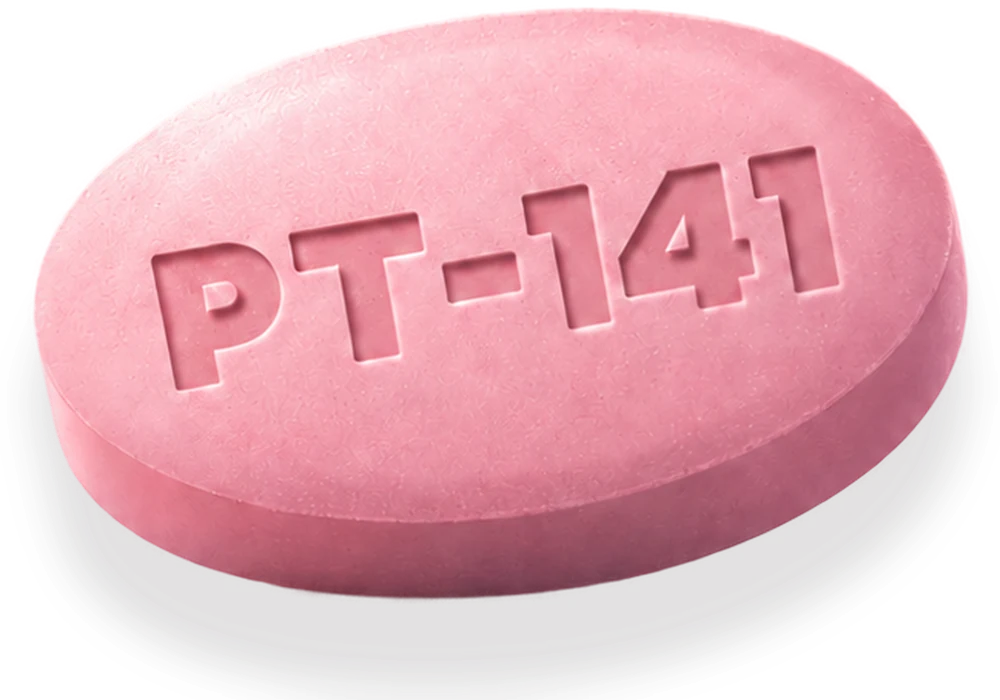
There is a particular kind of frustration that the entire erectile dysfunction industry has quietly ignored for decades. The pills work on the plumbing. They improve blood flow, they help the body respond, and for the mechanical problem of achieving an erection, they are often effective. But they do nothing at all for a different and, for many people, more fundamental problem: not wanting to in the first place.
Desire and physical ability are not the same thing. A person can have perfectly functional vascular machinery and simply feel no drive, no spark, no wanting. And for that person, a blood-flow medication is an answer to a question they were not asking. This is the gap PT-141 was made to fill, and it is why the molecule is genuinely different from everything in the Viagra family.
PT-141, known generically as bremelanotide, does not work on blood vessels. It works on the brain. It acts on the neural pathways that govern sexual desire itself, upstream of the physical response. That single distinction is the reason it can do things no PDE5 inhibitor can, including being prescribed to women as well as men. This article is an honest account of what bremelanotide is, what the clinical evidence actually shows, and how CLYR offers it.
The short answer
PT-141 (bremelanotide) is a melanocortin receptor agonist that works in the central nervous system to influence sexual desire, rather than acting on genital blood flow the way sildenafil and tadalafil do. It is FDA-approved, under the brand name Vyleesi, as a subcutaneous injection for acquired hypoactive sexual desire disorder (HSDD) in premenopausal women, based on large Phase 3 trials. It has also been studied in men, where earlier-phase research showed real effects on erectile response through the same central mechanism, though it was never carried to FDA approval for men.
CLYR offers PT-141 as a compounded orally-dissolving tablet that also contains a low dose of oxytocin, the hormone associated with closeness and bonding, taken under the tongue on demand. This compounded combination is not itself FDA-approved, and it is prescribed only after a licensed provider reviews your history, with uncontrolled blood pressure and cardiovascular disease as firm exclusions. What follows is the honest picture of the science behind it.
Where PT-141 came from
The origin story is genuinely unusual and worth telling, because it explains the mechanism.
PT-141 is derived from a compound called melanotan II, which was originally developed as a sunless tanning agent, a drug meant to stimulate melanin production and darken the skin without sun exposure. During early testing, melanotan II produced an unexpected and consistent side effect in male volunteers: spontaneous erections and increased sexual desire. That side effect was striking enough that researchers isolated and refined the sexual-response component into a dedicated compound, bremelanotide, engineered to keep the sexual effect while minimizing the tanning activity.
That heritage is not just trivia. It is why the melanocortin system, the pathway both melanotan II and bremelanotide act on, turns out to be central to sexual desire, and it is also why one of bremelanotide's known side effects, with repeated use, is darkening of the skin. The drug's history and its biology are the same story.
How it actually works: desire, not plumbing
To understand why PT-141 is different, it helps to understand what it does mechanically.
PDE5 inhibitors, the Viagra and Cialis family, work peripherally, meaning they act on the body's blood vessels. They improve the vascular response that produces an erection. They do not touch desire; they assume the desire is already there and help the body act on it.
Bremelanotide works centrally, meaning it acts in the brain. It is a melanocortin receptor agonist, activating melanocortin-4 receptors (MC4R) in the hypothalamus, a region deeply involved in the regulation of sexual behavior. Through this pathway, it influences the neural circuitry of desire and arousal directly. Animal research helps confirm the mechanism: MC4R activation in a specific brain region increases dopamine signaling, and that dopamine effect is required for the behavioral response, block the dopamine, and the effect disappears. In other words, PT-141 works on the "wanting" circuitry of the brain, at the level of neurotransmitters, rather than on the blood vessels of the body.
This is why bremelanotide has been described as the first centrally-acting drug approved for sexual dysfunction, a genuinely novel mechanism. It is also why it can help when the problem is desire rather than mechanics, and why it is not sex-specific: the melanocortin desire pathway exists in everyone.
The evidence in women: FDA-approved, honestly modest
The strongest evidence for bremelanotide, and the basis for its FDA approval, is in women.
In June 2019, the FDA approved bremelanotide as Vyleesi for acquired, generalized hypoactive sexual desire disorder (HSDD) in premenopausal women. HSDD is, in plain terms, persistently low sexual desire that causes the person genuine distress, and it is one of the most common sexual health complaints in women, yet one of the least served by medicine.
The approval rested on a large, serious clinical program called RECONNECT: two identical Phase 3, randomized, double-blind, placebo-controlled trials that together enrolled roughly 1,250 premenopausal women with HSDD, treated over 24 weeks. Both trials met their co-primary endpoints with statistical significance: women taking bremelanotide showed greater improvement in sexual desire (measured on the Female Sexual Function Index desire domain) and a greater reduction in the distress associated with low desire (measured on the Female Sexual Distress Scale) than women taking placebo. A 52-week open-label extension found the improvements were sustained with no new safety signals.
Here is where honesty matters, because it is exactly the kind of thing overselling glosses over: the effect, while real and statistically significant, was modest in absolute terms. The improvement in the desire score was about 0.3 points greater than placebo on the measurement scale used. This is a genuine, FDA-recognized effect, not a miracle, it will not transform a person's sex life overnight, and it works best for women who have genuine HSDD and have not found other approaches helpful. That is the honest characterization the best clinical sources use, and it is the one worth trusting. A real, meaningful, measurable effect that is also not magic.
The evidence in men: real, earlier-stage, never approved
Bremelanotide's story in men is actually where it started, and the evidence is real but earlier-stage.
Before the pivot to HSDD in women, bremelanotide (and PT-141 before that name) was studied through the early 2000s specifically for erectile dysfunction in men. Multiple Phase 2 trials showed dose-related improvements in erectile response. The landmark work by Diamond and colleagues, published in 2004 in the International Journal of Impotence Research, found that PT-141 enhanced erections in response to sexual stimuli in men with ED, including, notably, in men who had already responded to sildenafil and, in companion work, in some men who had not responded to sildenafil at all. Crucially, some of the erectile response occurred without visual sexual stimulation, which supported the central (brain-driven) mechanism: the drug was generating desire and arousal centrally, not just enabling a mechanical response.
The honest caveat is significant. The male program was never carried through Phase 3 to FDA approval, in part because the FDA raised concerns about blood pressure effects with the intranasal formulation being used at the time. So bremelanotide is not FDA-approved for any use in men. Its use in men is off-label, supported by Phase 2 evidence and by extensive clinical experience, and grounded in the fact that the melanocortin desire pathway is not sex-specific, the mechanism that works in women operates in men too. That is a legitimate and well-established basis for prescribing, but it is a different and lesser tier of evidence than the women's approval, and any honest account says so.
One particularly relevant scenario: men on testosterone therapy whose levels are optimized but whose desire has not fully returned. Testosterone addresses some components of libido but not all, and the central desire pathway PT-141 acts on is a different lever. This is one of the situations where a central-desire drug makes the most sense.
The oxytocin layer
CLYR's formulation pairs bremelanotide with a low dose of oxytocin, and it is worth being straight about what that does and does not add.
Oxytocin is often called the "bonding hormone." It is released naturally during moments of closeness, touch, and intimacy, and it is associated with feelings of connection and attachment. The rationale for including it alongside bremelanotide is intuitive: if bremelanotide addresses desire, oxytocin is aimed at the closeness and emotional-connection dimension of intimacy, rounding out the experience rather than treating it as purely a matter of drive.
The honest framing, though, is that the clinical evidence for supplemental oxytocin in sexual function is less established than the evidence for bremelanotide. Reviews of the area note that oxytocin, despite a strong theoretical rationale, has not shown consistent, robust therapeutic benefit in controlled human studies, and that its effects may be primarily on the subjective, felt aspects of the sexual experience rather than on hard functional measures. So oxytocin in this formulation should be understood as a complementary component included on a reasonable rationale, aimed at the closeness dimension, not as a second proven drug. Your provider can discuss what to realistically expect from the combination.
Why an orally-dissolving tablet
The FDA-approved form of bremelanotide, Vyleesi, is a subcutaneous injection delivered by autoinjector. CLYR's version is instead an orally-dissolving tablet taken under the tongue.
The appeal is straightforward: no needle. For an on-demand intimacy product, the difference between a self-injection 45 minutes before sex and a small tablet that dissolves under the tongue is not trivial, it is the difference between a clinical act and a discreet one. The dissolving-tablet format also fits the on-demand nature of the medication, taken about 45 minutes before intimacy, no more than once in 24 hours.
It is worth noting honestly that the sublingual/ODT route is a compounded delivery format, not the FDA-studied route (which was injection). The molecule is the same; the delivery is a compounding choice made for tolerability and convenience.
Honest safety: what to know
Bremelanotide has a well-characterized safety profile from its clinical program, and several points are important.
Nausea is common. This is the most frequent side effect by a wide margin. In the trials, roughly 40% of women experienced nausea, most often with the first dose or two, and it tends to lessen with subsequent use. It is the single most important thing to expect. Other common effects include flushing and headache.
Blood pressure and heart rate. Bremelanotide causes a transient, usually modest increase in blood pressure and a decrease in heart rate for several hours after dosing. This is precisely why it is contraindicated in people with uncontrolled high blood pressure or known cardiovascular disease, and why those are firm exclusions in any responsible prescribing. It is also why the male intranasal program stalled historically. This is not a drug for someone with uncontrolled hypertension or significant heart disease, full stop.
Skin darkening. With repeated use, some people notice darkening of the skin, particularly on the face, gums, or chest, a direct echo of the drug's melanotan tanning-agent heritage. It is generally reversible but worth knowing about.
Not for daily use. PT-141 is an on-demand medication, taken before intimacy, not a daily one, and never more than once in a 24-hour period. It is also not for use in pregnancy or breastfeeding.
Because of the blood-pressure effect specifically, PT-141 is genuinely a medication that requires a provider to review your cardiovascular history before you take it. That is not a formality.
How CLYR offers PT-141
CLYR offers PT-141 as a compounded bremelanotide-plus-oxytocin orally-dissolving tablet, prescribed only after a licensed U.S. provider reviews your intake, screens your blood pressure and cardiovascular history, and confirms the treatment is appropriate. If your history rules it out, you are told and not charged. The tablet is prepared by a state-licensed compounding pharmacy and shipped in plain packaging.
This is the point in CLYR's sexual health lineup that addresses desire specifically. Where CLYR Tempo works on the erection itself, the blood-flow side, PT-141 works on the wanting. For some people the issue is one or the other; for some it is both, and a provider can determine what fits. Because bremelanotide is prescribed to both men and women, PT-141 is also the option a couple can consider together, rather than a men's-only blood-flow product.
As with all compounded medications, the specific bremelanotide-oxytocin combination is not FDA-approved as a finished product, though bremelanotide itself is an FDA-approved molecule in its Vyleesi form. The honest distinction, an approved active ingredient delivered in a compounded combination and format, is one CLYR states plainly rather than blurring.
Frequently asked questions
How is PT-141 different from Viagra or Cialis?
PDE5 inhibitors like sildenafil (Viagra) and tadalafil (Cialis) work on blood vessels to improve the physical erection. PT-141 (bremelanotide) works in the brain, on the melanocortin pathways involved in sexual desire itself. One addresses ability; the other addresses wanting. Some people are prescribed both.
Can women take PT-141?
Yes. Bremelanotide is FDA-approved (as Vyleesi) specifically for premenopausal women with hypoactive sexual desire disorder. It is one of the few sexual health medications prescribed to both men and women, because the brain's desire pathway it acts on is not sex-specific.
Does it actually work?
In women with HSDD, large Phase 3 trials showed a real, statistically significant improvement in desire and a reduction in distress, though the effect is modest rather than dramatic. In men, earlier Phase 2 trials showed real erectile and desire effects, but it was never FDA-approved for men. It is honest to call it effective but not miraculous.
What is the oxytocin for?
Oxytocin is the hormone associated with closeness and bonding, included at a low dose to complement bremelanotide's effect on desire with an emphasis on the connection dimension of intimacy. Its standalone evidence is less established than bremelanotide's, so it is best understood as a complementary component.
What are the main side effects?
Nausea is the most common, affecting roughly 40% of users in trials, usually early and usually improving with use. Others include flushing, headache, a temporary rise in blood pressure, and, with repeated use, possible skin darkening.
Who should not take it?
Anyone with uncontrolled high blood pressure or known cardiovascular disease, because of its transient blood-pressure effect, and anyone pregnant or breastfeeding. A provider screens every case individually.
How do I take it?
One tablet dissolved under the tongue about 45 minutes before intimacy, no more than once in 24 hours. It is on-demand, not daily.
The Bottom Line
PT-141 (bremelanotide) is the rare sexual health medication that addresses the part everything else ignores: desire itself. By working on the brain's melanocortin pathways rather than on blood flow, it targets the wanting rather than just the ability, which is why it is FDA-approved for low desire in women and prescribed off-label, on solid earlier-phase evidence, for men. It is not a miracle, the effect is real but modest, nausea is common, and the blood-pressure caution is serious, but it is a genuinely novel and useful option for a genuinely underserved problem, and it is one of the only options a couple can consider together.
CLYR offers it as a no-needle dissolving tablet, paired with oxytocin for the closeness dimension, prescribed only after a licensed provider confirms it is safe and appropriate for you. If the issue is wanting to, not just being able to, learn more on the PT-141 product page.
Medical disclaimer
This article is for educational purposes only and does not constitute medical advice, diagnosis, or treatment. PT-141 (bremelanotide) causes a transient increase in blood pressure and is contraindicated in people with uncontrolled hypertension or known cardiovascular disease, and is not for use during pregnancy or breastfeeding. Bremelanotide is FDA-approved only as Vyleesi, a subcutaneous injection for acquired hypoactive sexual desire disorder in premenopausal women; its use in men and in a compounded oral-dissolving tablet with oxytocin is not FDA-approved, and compounded medications are prepared by licensed pharmacies without FDA review for safety or effectiveness. The individual research described reflects studies of bremelanotide, largely in its injectable form, and does not establish the compounded combination as a proven treatment. The decision to begin any prescription or compounded medication should be made in consultation with a licensed healthcare provider who knows your full medical history and current medications and who can screen for cardiovascular risk. Do not exceed one dose in 24 hours. Individual results vary.