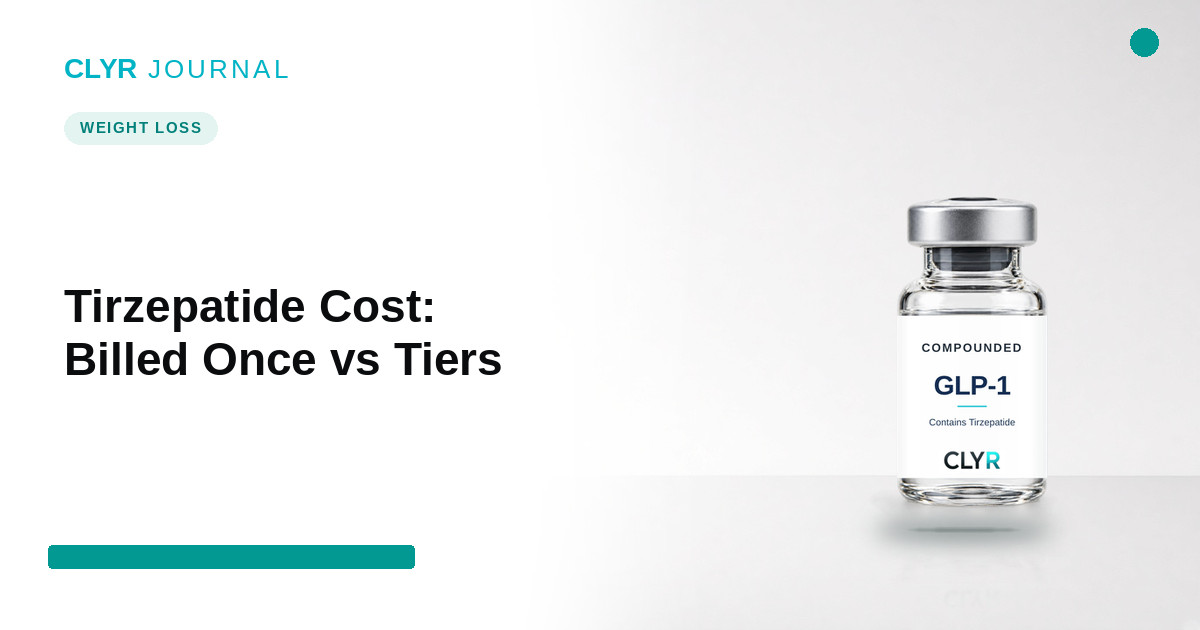
If you are pricing compounded tirzepatide in 2026, the number that matters is what you actually pay each month once the dose goes up, not just the first month. This guide lays out CLYR's compounded tirzepatide prices by dose, works out the monthly cost of each option, and explains what is included and what compounded means.
The short answer
CLYR's compounded tirzepatide starts at $149 for a first month at 2.5mg weekly. A 60-day new-patient plan is $269 (2.5mg, then 5mg), or about $134.50 a month. If you are already on a GLP-1, monthly prices run from $249 (5mg) to $329 (12.5mg), and two-month options bring that down to about $224.50 to $249.50 a month. Every option is billed once and nothing renews. The provider review, syringes and cold shipping are included.
What you are buying
This is compounded tirzepatide with vitamin B6, prepared by a state-licensed 503A pharmacy in a multi-dose vial and shipped cold with syringes. It is injected once a week. It is not the FDA-approved brand-name tirzepatide. Compounded medications are not FDA-approved and have not been reviewed by the FDA for safety or effectiveness. A licensed provider reviews your intake and decides whether it is appropriate before anything ships.
CLYR prices by dose
| Option | Weekly dose | Price | Monthly cost |
|---|---|---|---|
| New patient, 1 month | 2.5mg | $149 | $149 |
| New patient, 60 days | 2.5mg, then 5mg | $269 | about $134.50 |
| Current GLP-1 user, 1 month | 5mg | $249 | $249 |
| Current GLP-1 user, 2 months | 5mg | $449 | about $224.50 |
| Current GLP-1 user, 1 month | 10mg | $299 | $299 |
| Current GLP-1 user, 2 months | 10mg | $499 | about $249.50 |
| Current GLP-1 user, 1 month | 12.5mg | $329 | $329 |
| Current GLP-1 user, 2 months | 12.5mg | $499 | about $249.50 |
Each price is a single charge. There is no membership fee and no subscription to cancel. When your supply is running low, you reorder at the dose your provider sets.
Why the cost changes over time
Tirzepatide is started low and increased slowly. The FDA-approved label starts at 2.5mg once a week for four weeks, then increases in 2.5mg steps no sooner than every four weeks, based on how you respond and how well you tolerate it. That is why the new-patient options start at 2.5mg, and why the 60-day plan moves from 2.5mg to 5mg.
The practical point for budgeting: your first month is usually your cheapest. If your provider moves you up, your monthly cost moves with the dose. The two-month options are the lowest monthly price at each maintenance dose, and the 10mg and 12.5mg two-month options cost the same, $499.
What a realistic first year can look like
Doses differ from person to person, so there is no single annual number. As an example only: a new patient who starts with the 60-day plan ($269) and then stays at 5mg on two-month orders ($449 every two months) would pay $269 plus five orders of $449 over a year, or $2,514. Someone whose provider moves them to 10mg would pay more per order at first, then $499 every two months. Your provider decides the dose, not the price table.
How to compare prices fairly
When you compare telehealth offers for compounded tirzepatide, check these things before the headline number:
- Is it billed once, or is it a subscription? Some prices only apply with an ongoing plan.
- Does the price change with the dose? A low first-month price can rise as the dose increases.
- Are the provider review, syringes and shipping included?
- Who prepares it? It should come from a state-licensed pharmacy with your name on the label. The FDA warns against products labeled "for research use only" or "not for human consumption."
- Does a licensed provider review your history? The FDA's guidance on unapproved GLP-1 products tells patients to get these drugs only with a prescription from a licensed provider and only from licensed pharmacies.
The FDA also advises discarding multi-dose vials 28 days after first use and warns about products that are not shipped and stored at the right temperature. CLYR ships tirzepatide cold. For a broader view of no-membership pricing, see our guide to telehealth without a membership.
What the evidence shows
The evidence for tirzepatide comes from trials of the FDA-approved product. In SURMOUNT-1, adults with obesity or overweight without diabetes lost an average of 15% to 20.9% of body weight over 72 weeks, depending on dose, compared with 3.1% on placebo, alongside diet and activity changes (Jastreboff 2022). Compounded tirzepatide was not tested in that trial.
Side effects and safety
The most common side effects are nausea, diarrhea, vomiting, constipation and decreased appetite, usually most noticeable when starting or increasing a dose. Serious but rare risks include pancreatitis, gallbladder problems and kidney problems from dehydration. The FDA-approved tirzepatide label carries a boxed warning about thyroid C-cell tumors, and tirzepatide should not be used by anyone with a personal or family history of medullary thyroid carcinoma or Multiple Endocrine Neoplasia syndrome type 2, or during pregnancy. Our guide to managing GLP-1 side effects covers practical steps.
Frequently asked questions
How much does compounded tirzepatide cost per month at CLYR?
From $149 for a first month at 2.5mg. The 60-day new-patient plan is $269, about $134.50 a month. Current GLP-1 users pay $249 to $329 for one month, or about $224.50 to $249.50 a month on two-month orders.
Is it a subscription?
No. Every option is billed once and nothing renews. You reorder when you need more.
Is compounded tirzepatide the same as the brand-name product?
No. It is compounded with vitamin B6 by a state-licensed 503A pharmacy. It is not the FDA-approved brand and has not been reviewed by the FDA for safety or effectiveness.
What is included in the price?
The provider review, the medication, syringes and cold shipping. If you are not a fit, you are refunded in full.
Can I start at a higher dose if I am already on a GLP-1?
Possibly. The current-user options start at 5mg, but your provider sets the dose based on your history and what you are taking now.
The bottom line
Compounded tirzepatide at CLYR costs $149 for a first month, about $134.50 a month on the 60-day new-patient plan, and about $224.50 to $329 a month at maintenance doses, depending on dose and order length. It is billed once with nothing to cancel. Start the 60-day plan or start with one month. A licensed provider reviews your intake before anything ships. To compare the two main GLP-1 options, read semaglutide vs tirzepatide.
Medical disclaimer
This article is for educational purposes only and is not medical advice, diagnosis, or treatment. Compounded tirzepatide with vitamin B6 is a compounded prescription medication; compounded medications are not FDA-approved and have not been reviewed by the FDA for safety or effectiveness. It is dispensed only after a licensed provider reviews your intake and determines treatment is appropriate. Do not use tirzepatide with a personal or family history of medullary thyroid carcinoma or MEN 2, or while pregnant. Not everyone qualifies, and individual results vary. Call 911 in an emergency.