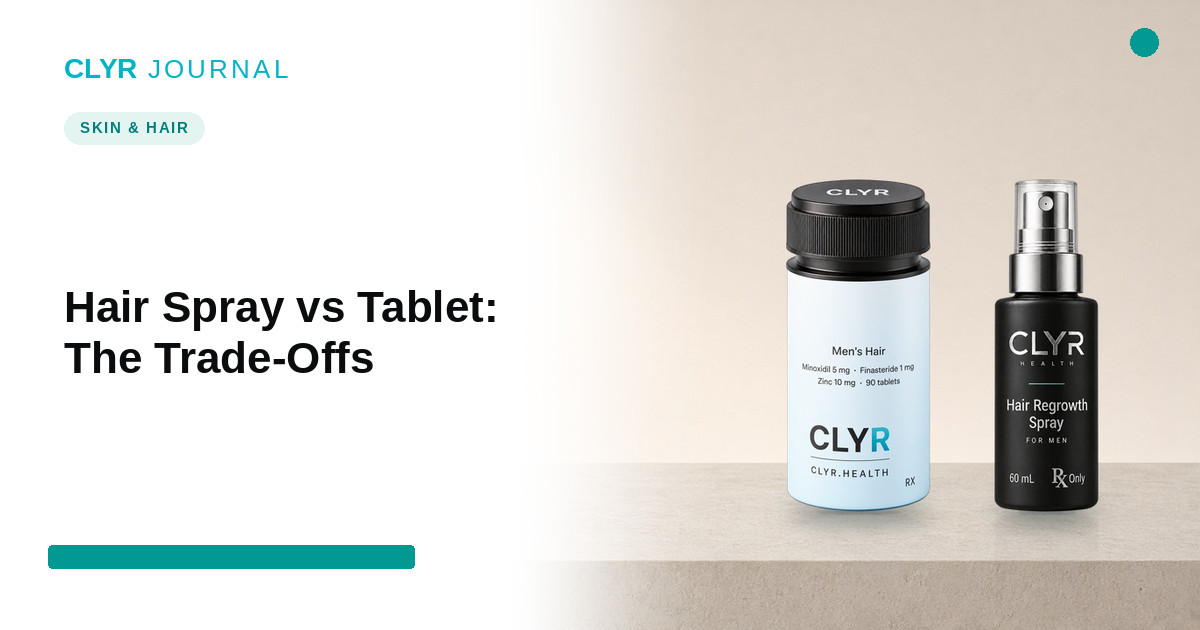
CLYR offers two prescription options for men's hair loss built on the same two ingredients, minoxidil and finasteride: a daily tablet and a topical spray. They cost about the same. The real choice is about where the medicine goes, which side effects you would rather risk, and which routine you will actually keep. This guide walks through those trade-offs. For a full deep dive on the tablet itself, read our guide to oral minoxidil and finasteride.
The short answer
The Men's Hair Tablet is one pill a day with minoxidil 5mg, finasteride 1mg and zinc 10mg: 90 tablets for $129. The Men's Hair Spray is applied to the scalp and combines minoxidil 7%, finasteride 0.2%, tretinoin 0.025% and fluocinolone 0.025%: 60 mL for $119. The tablet wins on convenience and works throughout the body. The spray keeps more of the medicine on the scalp, which some men prefer if they are concerned about whole-body side effects. Both are compounded, both are off-label, and a licensed provider decides which, if either, is appropriate.
Side by side
| Men's Hair Tablet | Men's Hair Spray | |
|---|---|---|
| Form | One tablet a day | Solution applied to the scalp |
| Actives | Minoxidil 5mg, finasteride 1mg, zinc 10mg | Minoxidil 7%, finasteride 0.2%, tretinoin 0.025%, fluocinolone 0.025% |
| Price | $129 for 90 tablets | $119 for 60 mL |
| Where it acts | Whole body | Mostly the scalp, with some absorption |
| Main trade-off | More whole-body effects | Daily application, scalp irritation, transfer risk |
Both are billed once and prepared by a state-licensed 503A pharmacy after a provider review. Nothing renews.
Trade-off 1: side-effect profile
Minoxidil. Taken by mouth, minoxidil reaches the whole body. Oral minoxidil at full strength is a blood pressure medicine, and its FDA label carries strong warnings, including fluid buildup around the heart, for that use. Hair loss doses are much lower, and an international expert consensus published in 2025 described low-dose oral minoxidil as a reasonable option for hair loss with screening and follow-up (Akiska 2025). The side effects most often discussed at low doses are unwanted hair growth elsewhere on the body, swelling, a faster heartbeat and lightheadedness. A 2025 meta-analysis of four randomized trials (279 patients) found oral and topical minoxidil had similar effectiveness, with more unwanted body hair growth in the oral groups (Sobral 2025). Topical minoxidil is more likely to cause scalp itching or flaking.
Finasteride. Finasteride lowers DHT, the hormone behind male pattern hair loss. The oral finasteride 1mg label lists sexual side effects, such as lower libido and erection or ejaculation changes, in a small share of men, and notes that finasteride lowers PSA test results. In a phase III trial of a topical finasteride spray, blood levels of finasteride were more than 100 times lower than with oral finasteride 1mg, and the drop in blood DHT was smaller, while hair counts improved compared with placebo (Piraccini 2022). Lower body exposure does not mean zero: finasteride applied to the skin is still absorbed.
The extras in the spray. Tretinoin helps minoxidil penetrate the scalp but can cause dryness and irritation. Fluocinolone is a mild steroid included to calm that irritation. Your provider will ask about scalp sensitivity.
Trade-off 2: convenience
The tablet is a single daily pill with nothing to apply, nothing to dry, and no effect on how your hair looks or feels. It is easy to keep up, which matters because both treatments only work while you keep using them.
The spray asks more of you. It goes onto a dry scalp, needs time to absorb before you style your hair or lie down, and has to be applied consistently. Some men do not mind this at all. Others find a daily topical routine is what makes them stop.
Trade-off 3: people around you
Finasteride can be absorbed through skin. With the spray, that means letting it dry fully, washing your hands after applying, and avoiding contact between treated scalp and a partner or children, especially anyone who is or could become pregnant. With the tablet, the label's caution is narrower: women who are or may become pregnant should not handle crushed or broken tablets.
Who might prefer the spray
- Men who want less whole-body exposure to finasteride and minoxidil.
- Men with low blood pressure, heart concerns or a history of lightheadedness, if their provider prefers a topical route.
- Men who are worried about unwanted body hair growth from oral minoxidil.
- Men who already have a daily scalp routine and will apply it consistently.
Who might prefer the tablet
- Men who will not keep up with a daily topical.
- Men whose scalp gets irritated by topical products.
- Men who live with others and want to avoid any topical transfer risk.
These are starting points for a conversation with your provider, not rules. Your medical history decides what is appropriate.
Frequently asked questions
Is the spray as effective as the tablet?
There is no head-to-head trial of these two exact formulas. A meta-analysis of oral vs topical minoxidil found similar effectiveness, and topical finasteride improved hair counts compared with placebo in a phase III trial. Your provider weighs effectiveness against side effects for you.
How much do they cost?
The Men's Hair Tablet is $129 for 90 tablets. The Men's Hair Spray is $119 for a 60 mL bottle. Both are billed once, with nothing renewing.
Are these FDA-approved?
No. Both are compounded by a state-licensed 503A pharmacy, and use of these combinations for hair loss is off-label. Compounded medications are not FDA-approved and have not been reviewed by the FDA for safety or effectiveness.
Can I switch from one to the other?
Yes, if your provider agrees. Some men start on one form and switch based on side effects or routine.
Does topical finasteride still have side effects?
It can. Blood levels are much lower than with the tablet, but some finasteride is still absorbed, and it can transfer to others through skin contact.
The bottom line
The tablet and the spray share the same core ingredients and cost about the same. The tablet is simpler and acts throughout the body; the spray keeps more of the medicine on the scalp but asks for a daily routine and care around others. Start an intake for the spray or start an intake for the tablet, and a licensed provider will review which option is appropriate. For more on the tablet, read the oral minoxidil and finasteride deep dive.
Medical disclaimer
This article is for educational purposes only and is not medical advice, diagnosis, or treatment. The CLYR Men's Hair Tablet (minoxidil, finasteride, zinc) and Men's Hair Spray (minoxidil, finasteride, tretinoin, fluocinolone) are compounded prescription medications used off-label; compounded medications are not FDA-approved and have not been reviewed by the FDA for safety or effectiveness. They are dispensed only after a licensed provider reviews your intake and determines treatment is appropriate. Finasteride can be absorbed through skin; women who are or may become pregnant should avoid contact. Not everyone qualifies, and individual results vary. Call 911 in an emergency.